

I was at the beach today for Easter weekend, the sun shining and the world was great. I went for a swim and saw two young kids playing in the sea, a sight that can’t help but to bring a smile to one’s face. Such joy and innocence, nothing else at that moment matters to them except for doing the first thing that comes to mind. There are no barriers to joy and no considerations of social norms or self-consciousness, they’ve never had an invasive thought about what needs to be done when they return to the office. As I waded through the water past the two children playing, I looked up and saw their parents watching them, well, not actually watching them. They were watching their children through a screen, present in body, absent in mind; both parents had their phones recording this moment of joy.
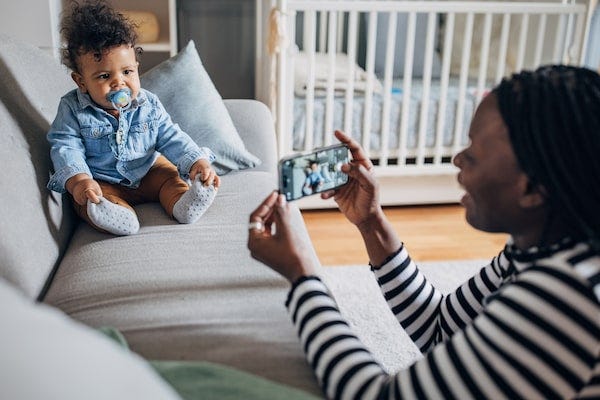
I hadn’t expected it, but it made me sad. Something that had brought even a complete stranger happiness, was being registered through the screens of loved ones instead of being lived together. I think if it was just one of them recording, my brain would have normalised that and moved on, but seeing both of them with phones stuck with me. I grew up before the smartphone, I have many early memories of achieving something and knowing I did good by the look of pride on my parents’ face. Every parent has that look, that look of ‘wow you’re so special’ after you do the most basic of things. I fear the children of today will have less of those special moments with their parents because there will be a phone between the achievement and the watering eyes of pride.
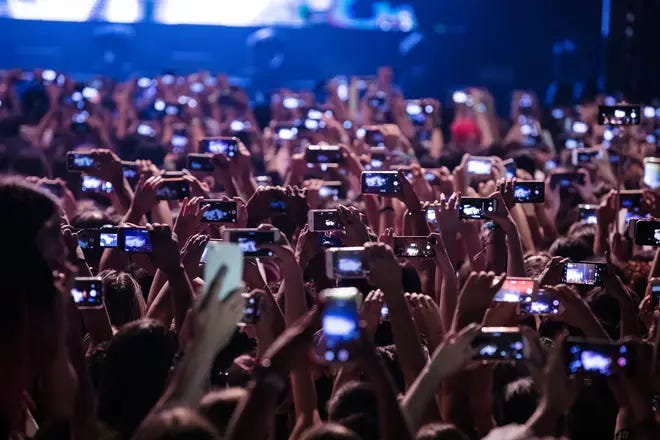
I had a discussion with my French teacher recently about why it is the kids of today have such a nostalgia for the 90’s. My response was that the 90’s and early 2000’s is the time where things were both recorded to a quality that seemed real but were also before smart phones destroyed everything. There is a nostalgia for anytime before the iPhone. Maybe the 90’s looked better because people had to be more selective with what they recorded, film was valuable and finite. Infinite access to an indulgence rarely results in a beneficial outcome. When we no longer had to be selective with what memories to capture, we developed an ironic sense of missing out if we don’t experience things through the lens. Do it for the gram became a lifestyle and through it we lost our ability to do it for the moment.
My brother and I did a trip to Patagonia when I was younger, I have such fond memories of that trip. I was 18 and ready to see the world, my older brother had already done a lot of travels and was willing to lead the way. We stayed in hostels and aside from the occasional person on their laptop trying to look at emails, people hung around waiting for someone to talk to. I had a phone with a good enough camera and no sim card, it allowed me to capture memories without being distracted. My Motorola couldn’t send me notifications even if it wanted to, but I was in control and that’s how it should be.
The general thesis for that trip was ‘we are going to see some amazing things, let’s get the photo, or future memory out of the way and then soak this up’. Getting the shot did play an important role in reinforcing those memories in the future (now), but nothing will beat the memory of looking up at the top of Fitz Roy Mountain while the sun hits the face. I was there, we were there, it brings water to my eyes just to know how lucky I was to experience that in my lifetime. If the history of man was a thick book, only those who were mentioned on the last page are able to experience air-travel and the ability to see the world without taking great risk or time to do so.

There were many reasons to take photos, but as soon as the photo was taken it was put back into my backpack. The phone wasn’t able to ring, there was no world where I picked it up to take a photo and get distracted by a notification, the phone wasn’t a phone in the sense we know now, it was actually just a bad digital camera. I think about how we used to use cameras. I’ve taken some disposable cameras on trips recently and the decisions you make with them remind me how much we waste with phones.
Before leaving the house you have to first ask yourself if it’s worth bringing the camera at all, because it is inconvenient to carry. You take stock of what you’re planning to do and whether there’s going to be anything interesting enough to justify the inconvenience. When you’re taking the photo you have to think about whether it’s worth taking, you only get 30-something shots and maybe you only have one or two rolls of film. Each photo taken is worth some thought, even if it’s an instant, before pressing the button. In that friction before action is the most beautiful thing in the world. Deliberate consideration of whether this moment should be lived, or captured.
We no longer have that friction, which means we no longer have that beautiful moment. We are robbed of deliberate consideration and we are robbed of our decision whether to live the moment or whether to watch it through a screen. So often are our phones in hand and so optimised is their software, that a photo can be taken almost autonomously. Babies are able to navigate iPads because they are intuitive and can be understood before language. I was on an airport bus the other day and I saw a teenager scrolling reels without watching them, he was not watching or listening to what was happening on his phone but his thumb was swiping in the trained direction.
Our response to something good happening in our lives is trained over time, it used to be to drop everything and focus on this unique thing occurring in front of us, now it is to reach into our pockets and take a photo of it. If something is shocking or interesting or wonderful, our response is to capture it; but not for the future memory of the moment like I did in South America, it’s to show others we saw it. There is an ironic feedback loop of missing an experience so that you can show others you experienced it.
Charlie Munger once said show me the incentive and I'll show you the outcome. The issue is we don’t properly understand the risk and reward of this trade. When we decide to take a photo or a video, we trade a moment of our lives; one that can never be relived or experienced again. This trade can be worth it, I deeply enjoy seeing the photos of my past travels. There are some memories I remembered just now while looking through my photos to find the image of Fitz Roy. There are also many photos that I take so that I can share my experiences with my family that live on the other side of the world, these are photos taken with purpose and are worth taking.
I attended the Winter Olympics earlier this year, there is a photo of my brother and I standing between the Olympic rings, surrounded by a beautiful mountainscape that I will cherish forever. Two days later in Milan we went to the women’s figure skating finals and the woman in front of us recorded almost every minute of every routine on her phone. There are no rights and wrongs when it comes to what we place value on, but there is objective truth. I took a few photos during the warm-up, then put my phone away to watch incredible athletes showcasing their life’s work. I would hazard a guess that the woman in front of us enjoyed telling other people she was there more than actually being there.
Quite often we trade (many) moments for no personal reward, we trade our sacrifice for the potential brief enjoyment of strangers. We take our enjoyment in the idea of strangers being impressed rather than the enjoyment of being impressed ourselves. We work hard for months, save money and finally take that trip only to spend time curating stories that last for 24 hours. So often do we neglect present time with those we love in order to cosplay a better life on the internet.
Every time we touch our phones we run a gauntlet. The highest paid individuals and smartest people on this planet, backed by infinite resources, are working around the clock to capture your attention. Their weapons all rely on one trojan horse in the form of your smartphone. When we go to take a photo, we not only risk losing that moment, we risk being distracted from the moments both before and after the one we’ve committed to losing.
To properly assess if the trade is worth it, you need to understand what you’re up against. Finding ‘balance’ with an unbalanceable object, is an impossible task. We must acknowledge that we will lose most of the battles with our phone, most of the time. If we acknowledge this, then we must also include it in our calculations whether the trade is worth it. So in order for this to be a successful trade, we must have:
Present moment + likelihood of distraction ≤ reward of capturing
If the conditions are:
Present moment + likelihood of distraction ≥ reward of capturing
Then we should understand these parameters and use all our willpower to find that beautiful moment of friction and choose to live instead of take. We need to reframe our understanding of our relationship with our phone, there is no control to be established. It is either out of sight and out of mind or it is present and gnawing at our attention. The incredibly well-resourced teams behind trying to capture our attention will win almost every time if we open the gates and let the trojan horse in.
Our attention is our most important resource, it is the one global currency on which billions are at stake trying to capture. Instead of feeling guilty about spending time on our phones, we should simply acknowledge that we are very likely to lose the battle if we pick it up. If we can find even a moment of deliberation before making the choice to take a photo, then we regain some control over our lives. The next time the sun is setting and that familiar urge arises from your pocket, choose to enjoy the sunset. Maybe the next time your child does something you wish to record, put the phone down, look them in the eyes and tell them you’re proud instead.
so good, thx for writing…(from my phone)
I have used my phone less do not use instagram to upload photos anymore. I do however love listening to podcasts over watching shows. Thanks for a reminder to live in the now