

My grandfather spent decades telling people he was writing a book. His uncle was a prisoner of war who died in an interesting series of events that he wanted to tell the world about. He would spend hours tucked away in his office meticulously going over documents and triple checking details. Shooting off emails to travel guides.
Sometimes we wouldn’t see him for a while and Grandma would say that he’s doing his ‘book thing’. I think it’s common for people to start to think about writing memoirs and things of that nature when they grow older. Grandad passed away during COVID, he never finished his book, I still don’t know his uncle’s story.
Earlier this year when I was back home I saw the printed copy of his draft. I love to read and was curious to see the end product of all such toil. It read much more like a 3-week itinerary with some notes along the way rather than anything resembling a novel. It took me no longer than 15 minutes to read through the compilation of emails, pictures and diary entries from the trip.
I think of him stepping away from loved ones to spend time alone writing, much like I am right now, seeking perfection that never arrived. Or maybe he just sought solace and found peace in trying to complete a task he was bound to leave incomplete. My Grandma loves puzzles, perhaps this was Grandad’s infinite puzzle.
It reminded me of Joseph Grand’s character in The Plague who would spend months trying to perfect the opening sentence of his novel. He successfully completes a sentence, but dies before a paragraph is ever written.
After Grandad died, something unexpected happened. Gma (his wife and my grandmother) told us she’d written a full account of her life. It turned out that while Grandad was publicly telling everyone he was writing and privately not making much progress, Gma was doing the opposite.
She had kept a diary for most of her life, using them as guidance and with a very astute memory, she managed to write 148 pages about her life from birth until today. She continues to update it each year life ticks on, of which she has had 88 of them so far. Long may they continue.

Gma also reads my articles (hi). We once spoke about her writing premise vs Grandad. She said that he would always obsess so much over details while she just wrote. She was rather proud of her spelling errors and very much wrote in her own voice. There’s some fantastic highlights that perhaps I’ll share one day, but you can tell she was born and raised in Australian sheep-shearing country.
Legacy
I’ve been thinking a lot about legacy lately. Maybe it was prompted by my Gma quietly succeeding in what everyone hopes to do before the end of their days; recording their story and having people care enough to read it. Maybe it’s my age, and that the conversation about having kids is on the table.
Whatever it is, inspiration continues to pull at me. I write a lot about living for the moment, but is it worth living for your legacy? Is there anything to gain from wondering what people will think about your short time in the world once you are gone?
There was a time a few years ago, while feeling edgy and reading existential literature that I might have said that anything after death is ego. Maybe I might have even been so edgy as to say that the same was true with life.
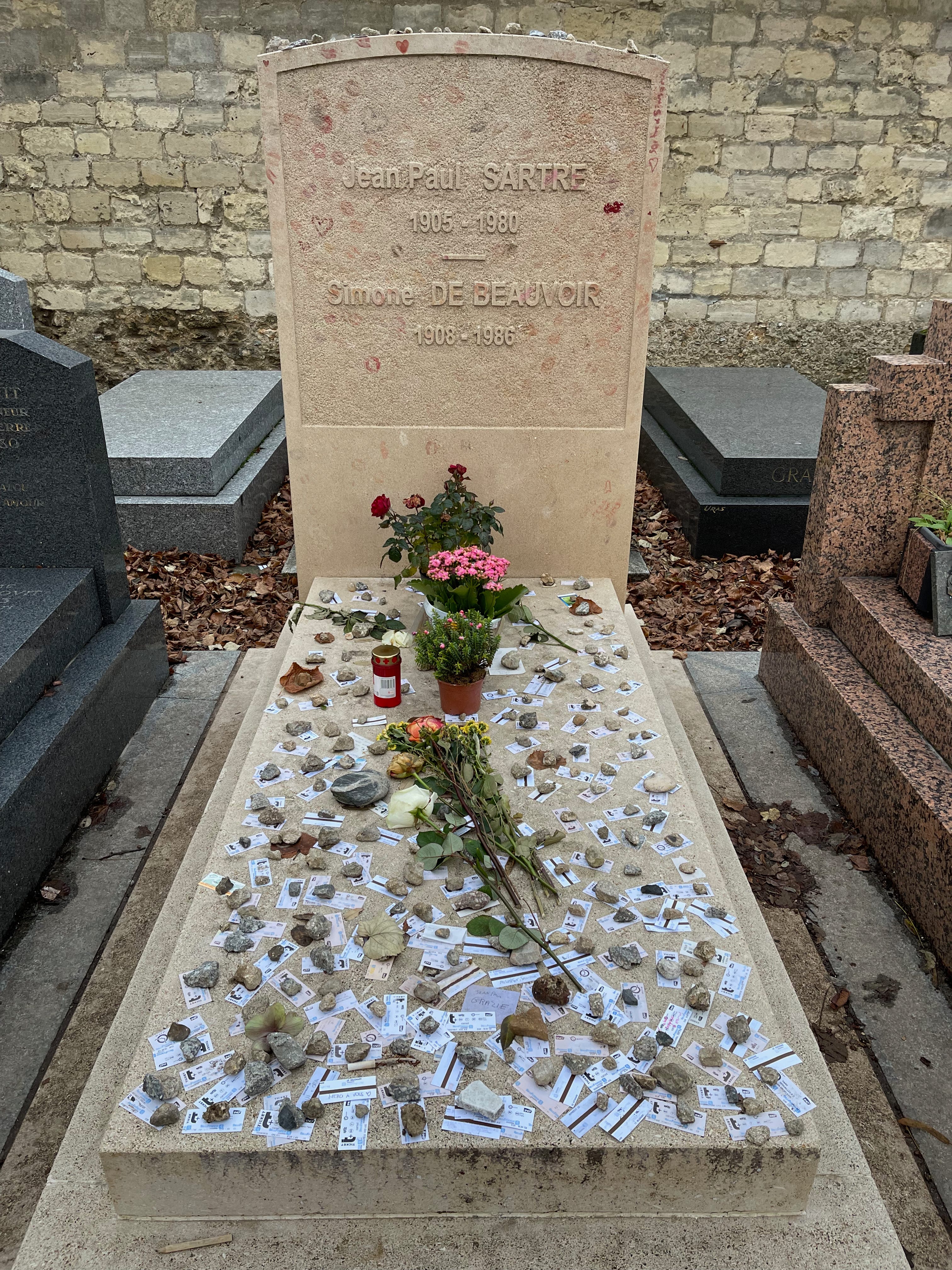
I remember reading Sartre during a dark time in my life and thinking that legacy was trivial and meaningless. A few weeks ago I was walking the streets of Paris and accidentally happened across Sartre’s grave. It was engrossed in fresh flowers and love from fans.
It struck me as ironic that a man who spent his life saying nothing matters, ended up mattering to a lot of people. I think there’s something interesting to pause on there, even if you don’t intend on inspiring people, if you are driven to create you might accidentally end up doing so.
Time
We all rest with the knowledge that we won’t matter on a long enough time horizon. Dinosaurs walked the Earth for millions of years and now serve the purpose of being burnt to fuel cars. They are our version of the microverse battery from Rick and Morty.
With most problems, it is important to zoom out but not too far. It can be helpful to view your own circumstance through a wider lens and realise that it’s not so bad, but it can be unhelpful to view legacy the same way. The impact we have on people today will change the future.
If we can be remembered in a generation or two, then we have won. Any more is a bonus. Most people who have ever lived didn’t even make it to a family tree, and a sickening amount never even had names. Yes, one day we will return our atoms to the sky, but there are many beautiful things that lay ahead in between.
Why
Sometimes I wonder what drives contemporary people to do great things. Most great deeds that were accomplished in the past were driven by religion and powered by some form of slavery. Gaudi worked until his death in the pursuit of an impossible task for an unproveable God.
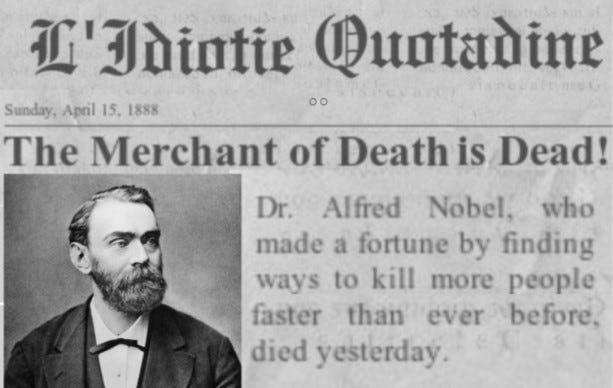
If not for God, then it’s usually about wanting to be remembered. Wanting to be known as someone who contributed. A French newspaper mistakenly published an obituary for Alfred Nobel in 1888 calling him a “merchant of death” for being the inventor of dynamite and making a fortune.
He was still alive and decided to dedicate his wealth to celebrating human achievement and peace. And so, the birth of the Nobel Prize. Our death finalises our story, until death all remains possible. The rest is still unwritten, as one great poet (Natasha Bedingfield) once put it.
I wonder if my legacy would be better if I died right now. Or will I be considered much more important when I die at the ripe age of 184 by drowning in sour gummy worms? Our death is our time capsule to the world.
I think we all fantasise about what people would say at our funerals. Would people mourn a world without my loud laughter and mid-tier newsletter? Even more delicious is fantasising about what people would think.
No one talks bad about a dead man, but everyone thinks earnestly. What would my friends think? Would they dream of days gone by, of memories created together? Would fresh tears come each day or would hedonic adaptation dissolve my essence every hour until I was just an annual ‘cheers to’ scheduled in the calendar year?
Ego
I think it’s healthy to think these thoughts, but it is also dripping in self-serving ego. Many a man has been lost in the obsession of what the crowd may think of him. Caesar famously (in the TV series Rome lol) said it is only hubris if I fail. But a question I want to ponder on for a moment, is where does one draw the line between hubris and failure in regards to legacy?
My girlfriend’s grandfather was loved by many. He had an Italian restaurant and a big heart. When he passed away, there was an entire cathedral packed out with people who wanted to pay their respects to him. He is spoken about regularly with smiles and wet eyes, included in stories about the impact he had on the people around him.
I think of this as legacy in its most authentic form. He did not need an obituary to push him back to the right path, he simply lived his life and did good by the people around him. This is the unintentional beauty of story-telling.
He also left behind a son, who would in turn play a role in creating and raising a beautiful girl. One who will proofread this with an adorable grin on her face (cue: ‘awww’). Inevitably, our legacy is to be found in every decision we have ever made, as it permanently alters the future that is to be lived by all those who will outlive us.
Creating
Each good deed creates a new world. A lesson taught can change the projection of a life, which in turn pivots generations. No one knows the man who taught Shakespeare how to write, but it was a worthy role to play in history. I feel my heart swelling at the possibility of my words planting seeds around the world that go on to grow into great trees.
Although it might be considered hubris that I believe my words are worth reading, I take comfort in potential failure. The act of sitting down and pouring out my soul is the best chance I have of impacting the world. My words may not be perfect, but they will live forever now that they have successfully exited my brain.
Nihilism suits those who will die with their thoughts unexpressed. I will be like my Grandmother, not my Grandfather.
“...what matters in life is not whether we receive a round of applause; what matters is whether we have the courage to venture forth despite the uncertainty of acclaim.”
Amor Towles, A Gentleman in Moscow
I’m sorry to hear about your grandad. This was a very thought provoking read for me (and also gave me a mild existential crisis because I’ve never thought about legacy in this much depth). I’ll probably circle back to this at some point. But very well written.
legacy mostly makes sense if you believe you have hard free will (simulate a million universes with exact same state of every particle and in each you are able to make a different decision at a given point - meaning you are the full free maker of your decisions); then yeah makes perfect sense to slap your name on the history leaderboards as you brush shoulders with other free agents
but if you see how much (if not all) of what we do, is either causality or randomness; then who or what is having a legacy?
this doesnt mean fatalism or nihilism is the way, doing great things is amazing in itself even if we fail, very much like what you say about writing; sometimes we win sometimes we learn, who's to say whats better