

When I was younger, my dad used to tell stories in the car. Maths problems drawn out in Australian slang, told quickly, designed to challenge my brain. Johnny had five marbles, lost three, found ten more, someone beat him up and took half; how many does he have left? Maths was gamified and turned into a competition between siblings and friends.
As a result of this, I learned to calculate quickly and enjoyed doing times-tables in school. I thought maybe maths could be my thing until algebra reared its hideous head and spoiled my genius. Maths became more about showing your process than getting the answer and the pace of finding the answer became almost meaningless. I could not fathom why I was being asked to show my thoughts on a page if I could answer the question correctly. But now I understand.
Mathematics is about proving you deeply understand a certain concept so that you can apply it elsewhere, there is little point in being able to get close to an answer without showing your work, because your work is your understanding. Without the process and the path to the result, the result isn’t very important. In school you are not solving impossible equations, you are being taught to understand. If you can’t talk about how you did it, then you haven’t been taught correctly.
I’ve been thinking lately that this concept of proof-of-work is more important now, that maybe my maths teacher had a point. In the age of optimisation there are few things that we cannot solve with the ‘help’ of AI systems. What if Syndrome had a point?
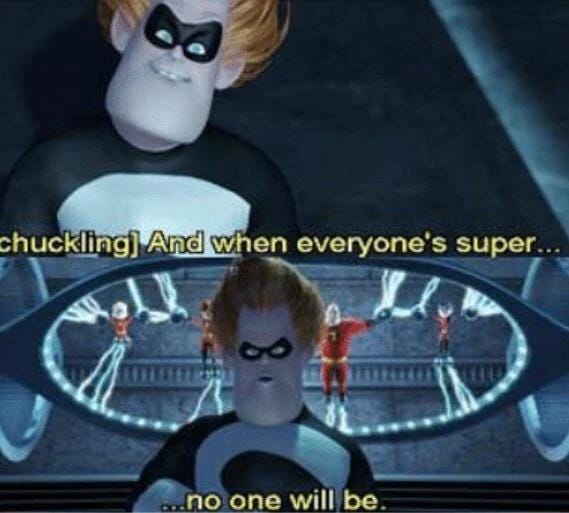
With everyone now turned into super humans able to answer any question in the world, cognitive mediocrity is justified, perhaps even encouraged. The special sauce is now only to be found in those who understand the process, those who actually know how to get the answer not just those in possession of the answer.
I’ve often thought about what I’d do if I were in a movie and travelled back in time to the 19th century, what could I possibly contribute? I would come back with stories of cars powered by petroleum and planes flying in the sky, smart phones and the internet—but results are useless here. Only if I found someone who actually understood the potential of these systems could I contribute anything. More likely I would be labelled insane, or start a cult I suppose.
We are so optimised toward the result that the process is an afterthought. We are all the hares with a fear of becoming the tortoise. We read the summary without understanding the book. We watch the highlights of the game without appreciating the momentum shifts of each moment. There’s an obsession with optimisation that goes hand in hand with our shrinking attention spans, and we’re going backwards in literacy as a result. Going backwards in literacy means we’re losing our ability to form strong arguments and opinions. Not all things are meant to be optimised, some things are deeply nuanced and require hours of research and thinking to understand.
We see this everywhere, everything difficult must have a quick fix. In fitness, we have Ozempic and everyone’s current favourite: peptides. Quick side note, I find it hilarious seeing all the gym bros discuss drugs that sound super nerdy—"do you guys use H32948 or H4920 for your recovery stack?”
We need to reprogram ourselves to become healthier people over a long period of time, but instead we reach for the shortcut. I lost 12 kilos over the last 18 months. I came back from a long trip recently and hadn’t gained any weight. It wasn’t through deliberate conscious effort, it was because I had become a healthier person. I had developed healthier habits, I understood what my body needed better, I intuitively understood my previous sacrifice and did not want to go backwards. Change occurred over a long period of time, incrementally, and now I am simply the cumulative return of those positive changes.
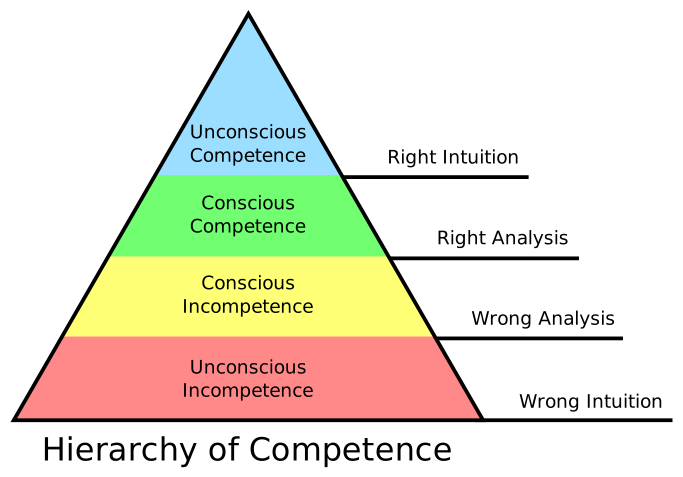
The hierarchy of competence is a great way to track your competence when learning a new skill. When I first decided I wanted to make a change, I had thought I ate pretty well and was in good shape. I was unconsciously incompetent, I didn’t know it, but I was way off in my understanding of what my body needed to function at its best. Once I started to educate myself I became conscious of that incompetence. Eventually, I took that trip and came home in the same shape as I left with routines in place—I was unconsciously competent, I was just being the new version of myself.
For some things, intentional friction is necessary for safety. Before you are able to receive a gastric bypass, there is a psychological evaluation as part of the formal clinical process. These sessions can often be up to eight hours total spread over multiple sessions. Psychologists assess your eating habits, medical history and most importantly your understanding of the surgery and what the result entails. They are assessing whether you understand the surgery is not a magic spell and whether you can actually function as the new person you need to be after it.
One of the main things that will disqualify you from positive marks is if you have a documented history of not following medical recommendations. The system is actively trying to rule out those looking for an easy result without understanding the process of lifestyle change. If only that was the case with all the things we have access to now.
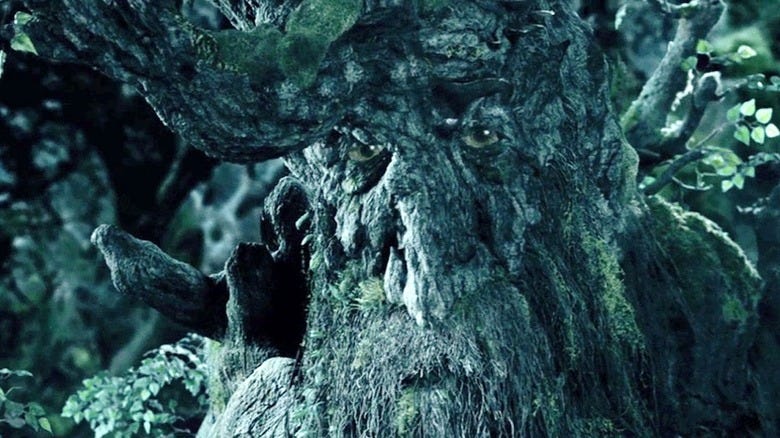
Imagine if we had to show our proof of work when defending our strongly held beliefs and opinions. How many performative people would be completely lost when speaking about politics or controversial topics? Their proof of process is: Grok said this, ChatGPT said that. That is not a process. That is a resource. You do not get a passing grade for showing your answer without your process. Wouldn’t the world be a better place? It reminds me of this quote from Treebeard: You must understand, young Hobbit, it takes a long time to say anything in Old Entish. And we never say anything unless it is worth taking a long time to say. Maybe we can learn something from the Ents, talking points aren’t meaningful discussion and some reels aren’t worth sending.
My greatest fear is we all become the Harvard bar guy in Good Will Hunting who quotes from a textbook and feels like he is in possession of great wisdom. We lose our agency in opinion and become performative vessels for OpenAI to speak through us. Instead of an AI agent working for man, man becomes an agent broadcasting AI.
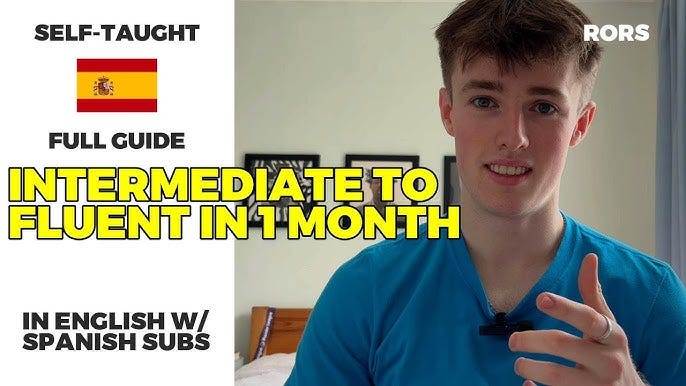
Through this culture of optimisation, we have lost the ability to appreciate detail. We used to revere directors and authors being meticulous about the small things. Now people are more likely to pick up their phone if there is a drop in action on screen. If you try to learn a language, you’ll find videos online of people advertising ‘fluency in one month’. They know this is unserious, but they also know their audience. Most people who pay a language teacher will have classes for a few weeks and become bored with the lack of results, just like a personal trainer.
I grew up in Australia where the water is warm and I could surf after school in tropical temperatures. When I moved to the EU and had to surf in the Atlantic, I hated how much friction there was involved with surfing. Trying to take off a wetsuit when you can’t feel your hands fucking sucks, but it is indeed part of the journey. I can appreciate how much I love something by how much I’m willing to sacrifice for it.
Experts can rarely afford to be confronting with the truth, no one will hire the PT who tells clients real change will happen over years and it might take 2-3 months of sacrifice to see noticeable progress. No one wants to talk to the teacher advertising that people need 100 hours of study before being able to talk with any kind of depth. People want the TikTok version, and if they watch enough of those, they feel like they’ve done the job.
We actually get a similar neural reward when watching someone else do something rather than us doing that thing, it’s called vicarious reinforcement. It’s the reason you can watch a few tutorials on Youtube and feel like you’ve been productive all while actually doing nothing.
I encourage people to embrace friction. Optimise the things that should be optimised, get a dishwasher, buy an automatic garage door, automate trivial things. But don’t optimise literature. Don’t optimise things that need slow change, because without the process you lose the actual transformation.
The result is at best temporary and in most circumstances a myth. It is simply a future oasis that we install in our brains so that we can find the motivation to continue our journey forward. There is no result that ceases our need to continue, the work is never done. There is no point in which one has ‘learned a language’, it is a lifetime pursuit. There is no end-state of happiness to be achieved. Just because we lost the weight doesn’t mean we can lay in bed all day. By focussing on the result, we allow hedonic adaptation to take away the sweetness of the journey.
Michelangelo spent 4 years painting the Sistine Chapel, lying on scaffolding painting upwards, inspired by something greater than efficiency. Dostoevsky was under extreme financial pressure due to gambling debts and needed to produce something new. He had completed most of it but as he writes to a friend in 1865 “I burned it all. Now I can confess it. I wasn’t pleased with it myself. A new form, a new plan captivated me and so I began over again.” Along his journey his result changed, as it so often does. Sometimes we set out to do something good and through it we become great. The novel he would end up creating after burning the mediocrity was Crime and Punishment.
Vladimir Nabokov once wrote to his editor at The New Yorker “Why not have the reader re-read a sentence now and then? It won’t hurt him.” If we optimise for convenience we often optimise for mediocrity. If we cannot show the proof of our thinking, then we haven’t thought at all.

Enjoyed reading this! Was really moved by this bit:
When I moved to the EU and had to surf in the Atlantic, I hated how much friction there was involved with surfing. Trying to take off a wetsuit when you can’t feel your hands fucking sucks, but it is indeed part of the journey. I can appreciate how much I love something by how much I’m willing to sacrifice for it.
For me, I really committed myself to learning film photography these past few years and while expensive, buying and waiting for the development is so worth it
Thank you I needed to hear this today