

I’m almost in my 30s now. Which naturally means I have some friends who are training for Ironmans. How the fuck do you spell it, it is Iron Mans? Ironmens? IronMans? Idk. I may not be able to spell it but I do have fairly strong opinions on them.
Firstly, I think that the cycling leg does not belong. If we are to truly test how far we can push the human body, it is my belief that it should be based on evolutionarily-important skills. Running and swimming pass my test of course, but expecting people under 55 to cycle? That’s just cruel.
When the bike was invented by some German guy in the 1800s it was initially called the Laufmaschine (running machine). It was called that because there were no pedals, it was just a quicker alternative to walking. The bike lost my full respect in the 1860s when the French added pedals.
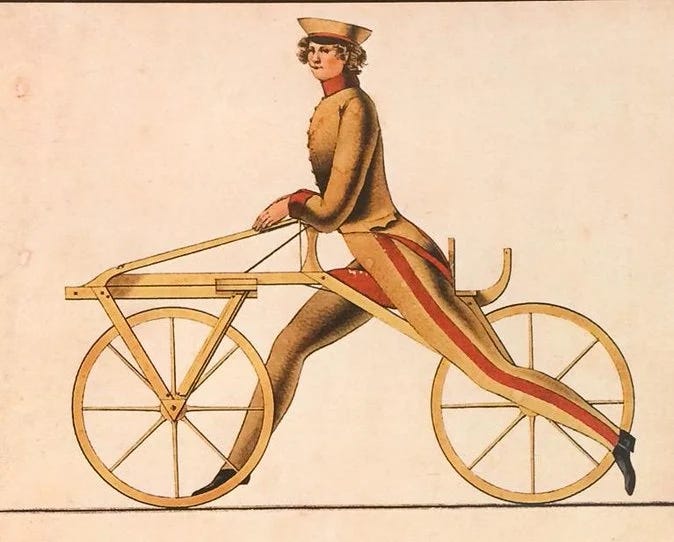
Although I might argue that the bike never had my respect at all. I was born by the sea and enjoy a very slow walking pace. I do not suffer the fast-walk-affliction most city folk seem to possess. Any machine intended to increase the pace of walking is not one that I align with.
One of my favourite words in French is ‘flâner’ which is basically just to walk around slowly and fuck about. It’s kind of like we say taking a stroll, but it’s better. I identify as a flâner man myself, in case you were curious, no wheels are required to enjoy the sun on my face and the sound of the sea.
So anyway, what does a fast walking machine with little pedals have to do with being at the top of your evolutionary function? I think we should create the Tungsten Man competition. You run, swim and then climb. Or maybe fight, or go hunt something idk. I’m not sure how you commoditise this but I’m sure people would do it to be the Tungsteniest of them all.
There is a contemporary obsession with doing something difficult and sweaty. I think for most of history people dreamed of collective greatness, how you could contribute to the whole. But now it seems like everyone yearns for individual greatness. We want to do great things but instead of reaching for unknown success in a deep pool, we strive for defined success.
In the capitalist world, every desire means potential profit. When someone signs up for an Ironman, they are dedicating everything in the pursuit of one big pat on the back. A shiny lil’ medal that proves they did something hard, something they can point to when they’re finally of cycling age (55 should be the minimum age for lycra).
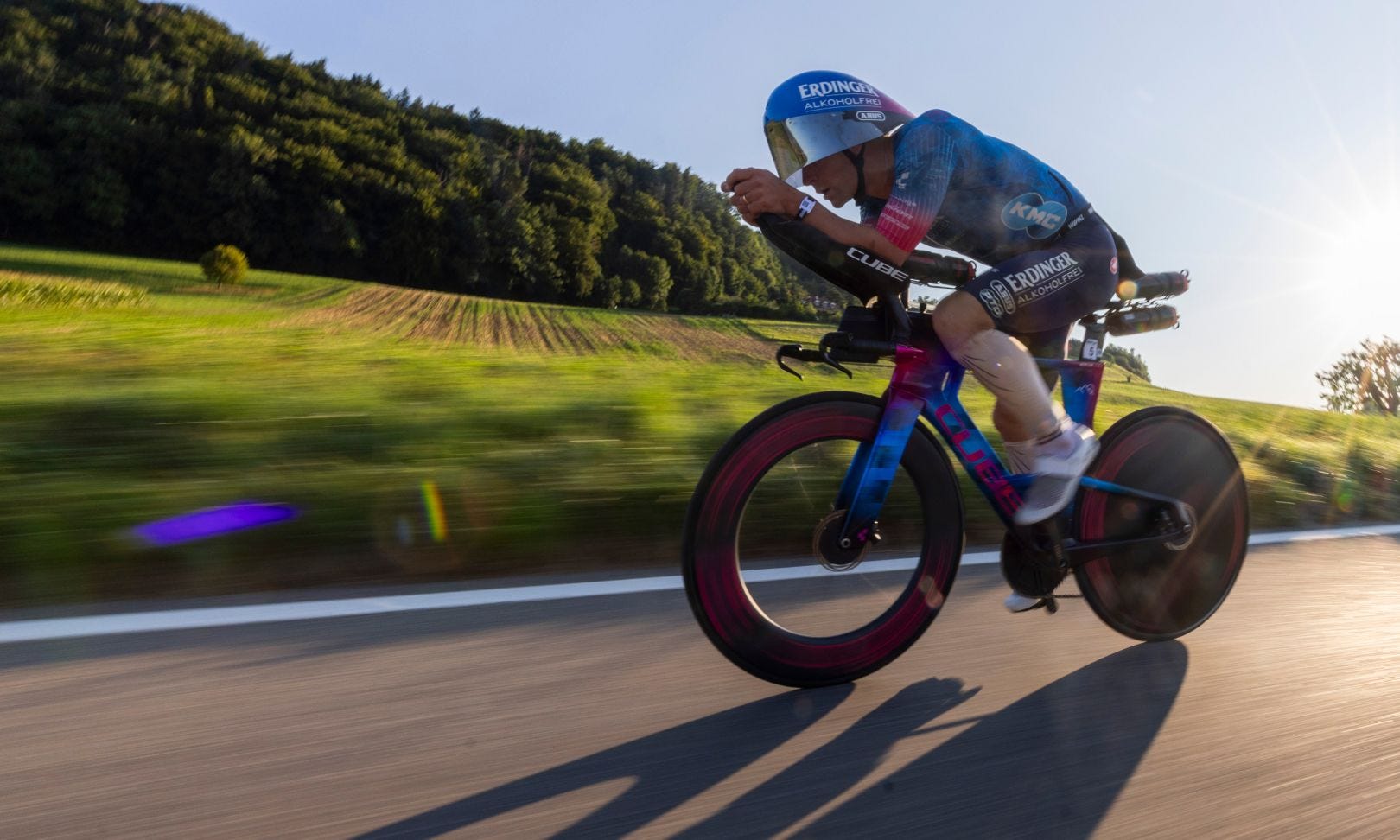
They are told that by finishing this race they have done something great, because that is how it is sold. Although the definition may be up for question, as some have astutely pointed out there is a definitive surplus of pedals involved, but the branding has succeeded.
My issue with Ironmen (Ironmans?) and other things of that nature is that it is packaged as the hardest thing someone can do. It is my thesis that it is part of a swathe of the lazy options. There you go, boom, I said it. Doing an Ironman is a version of laziness. They are the path of least resistance.
Everything is defined before you begin, it is not mentally stimulating. You are completing defined distances, with a defined training load and then you get a defined cute little backpack. It is like signing up to a modern day Karate class knowing that in 2 years you will get a blackbelt, because you paid for the classes and showed up.
You will of course learn a lot and feel accomplished but your result is near inevitable. An inevitable result is far less challenging to pursue than an unknown one. Yes the work is gruelling, yes it requires extreme dedication and pain, but it is all defined.
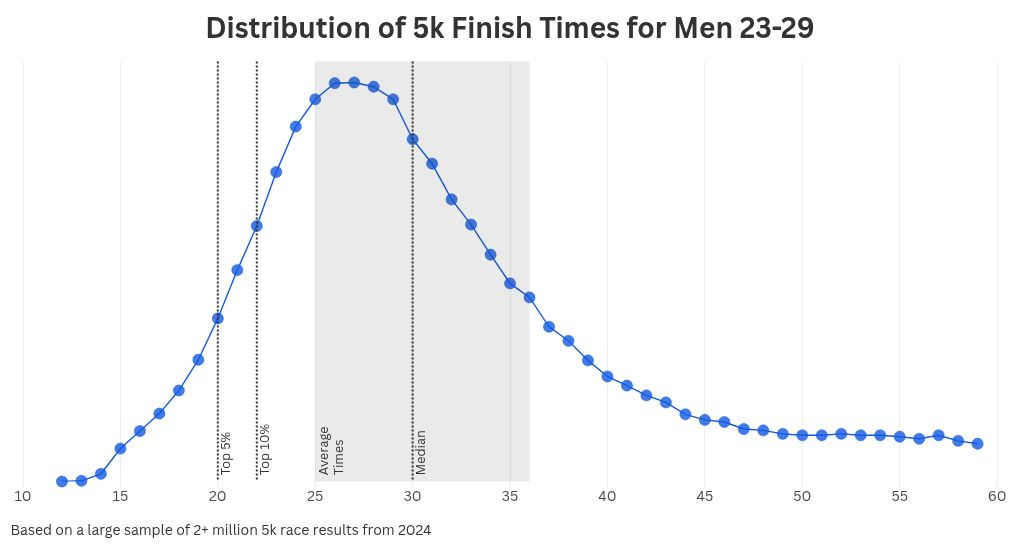
It is important to prove to yourself you can do hard things. I remember training for a sub-20 minute 5km time and feeling deep satisfaction when achieving it. It took a lot of work and I chose it because I wasn’t sure I would be actually able to do it. I also like to run and it felt like a good goal to challenge myself. I’m sure a lot of people feel the same after finishing an Ironman.
Although, and please humour me here, it can be argued quite legitimately that it is far more difficult to achieve the sub 20min 5k than crossing the finish line of an Ironman, but perhaps that is too much salt in the wound for now. It would be too much to even mention the idea of me achieving more elite status without ever touching a bike and training for far less time.
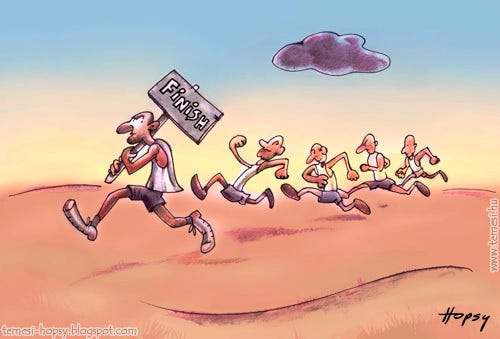
But there is comfort in knowing exactly what you need to do everyday in order to hit your goal, and there is laziness to be found in choosing defined success. You inherit and comply instead of creating and striving.
Edmund Hillary once said it is not the mountain we conquer but ourselves. When we dedicate all our time towards a goal that is not ours, we conquer the mountain without ever having to deal with ourselves. We are the harder battle to fight. How we define our own success, our own version of a good life.
Most people find themselves on the starting line because of a long journey of pushing their bodies. They started with a 10k, then a marathon, into a triathlon then maybe an ultra. Many are doing this because of the deep satisfaction that comes with achieving lofty goals, and this should be encouraged, but others do this as a search for something that will never arrive.
One of my friends who trained for an Ironman resented the entire process, finally finished and promised he’d never do it again afterwards. The next year he had signed up again in search of a higher score. He would go on to compete and not finish, instead of being satisfied with achievement of the first he sits with the bitter taste of not finishing the second.
With an Ironman, you need to train a fairly insane amount of time. A solid training plan is usually minimum 6 months and your dedicated training is somewhere around 10-14 hours per week on average. That’s about 300-350 hours of your life. For context, you can learn to speak a new language to a reasonable level in about 200-250.
As a trader, I like to think of everything as risk vs reward. If you spend 300 hours learning a language but fail some arbitrary test, you can still speak a language. If you allocate the same to Ironman training then you are still very fit regardless of your outcome, but the likelihood of it feeling empty is much higher.
It is also very likely that you don’t love running, swimming and cycling with the same enthusiasm. I like to run, I don’t mind swimming but I think you already know my thoughts on cycling. Committing so much of your time to something you don’t like or really care about is a poor allocation of time.
Our generation was born too late to explore the world but just in time for Instagram reels. You can no longer be a conquistador and sail the seas in search of Aztec gold, but you can watch people do exceptional things while scrolling on the couch.
We can’t all get to the Olympics, so instead we make up our own silly records. We run a marathon backwards on ice barefoot in denim jeans just to try and be the first. To try and find new trails to blaze in the very well-trodden world of exercise.
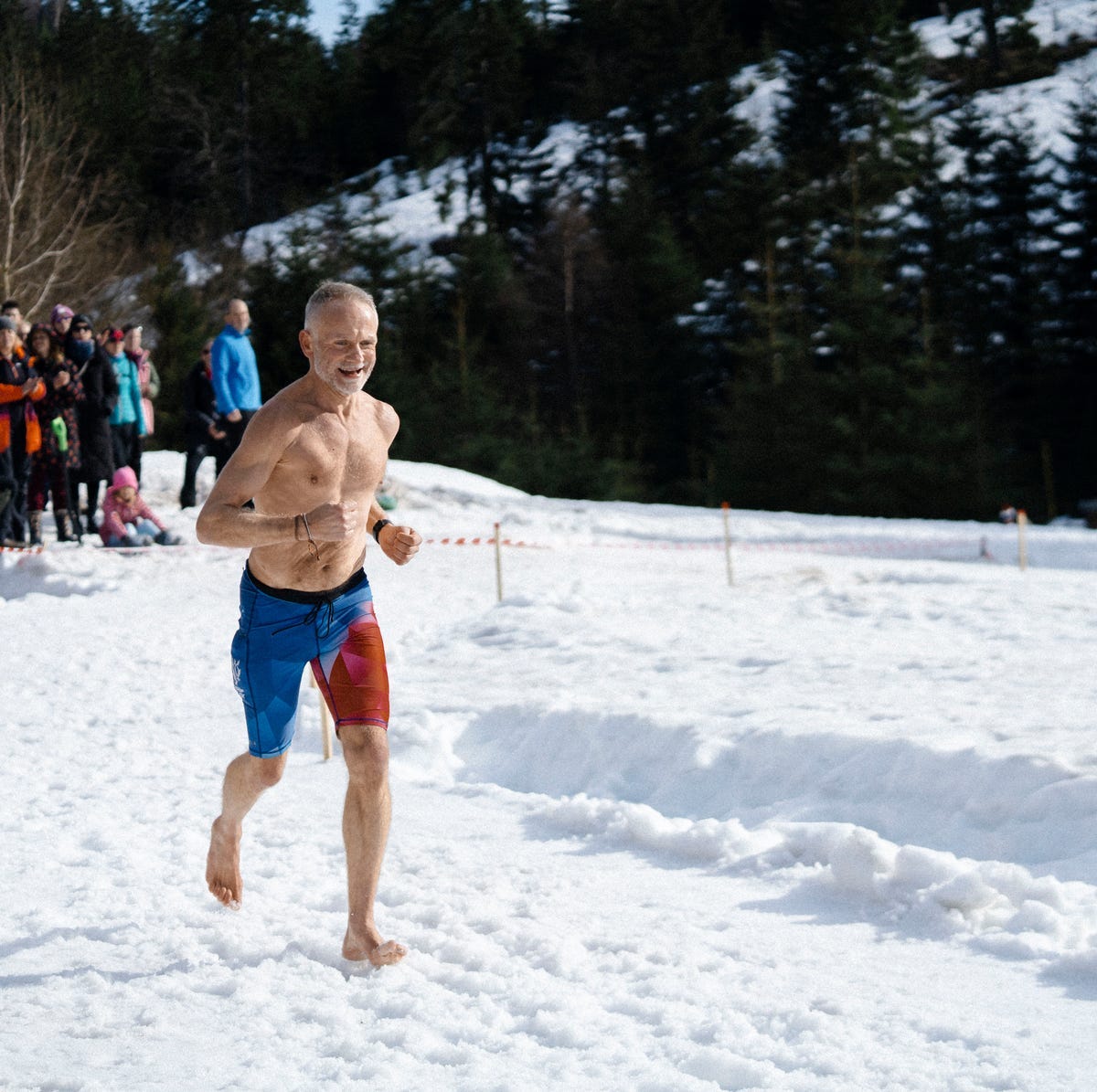
As much as the Ironmen amongst us believe it is their pure will, grit and determination that got them across the finish line. I would argue that it is all simply time and priorities, that’s all life really is. I look myself in the mirror and say that of course I could run a marathon, of course I could finish an Ironman.
There is no ocean I couldn’t swim across and there is no mountain I couldn’t climb, but I don’t want to do any of those things. I allocate my time to things directly attached to my values, to the things that make me happy. Just as I deem cycling as hobby-horse-riding for retirees, cyclists may think my language learning is a poor use of time (where’s the lycra????).
My goals are loosely defined but they are defined by the one person who should define them, and that is me. I want to continue improving my writing; maybe one day I will write a book. I want to continue learning languages, so maybe one day I can talk to people I never would have been able to.
The most difficult success to strive for is that which is immeasurable and without a finite finish line. The kind of success where you don’t have average heart rate as a reference point. Where there is not a specific time or race that needs completing, it’s turning up each and every day until you die to ensure a future version of you is better than the present.
When we reach for such specific big tasks, we set ourselves up for a predefined exit on our growth. Once the race is run, we either rest on our laurels or we expand the goalposts wider. Often what is needed is not a change of location it is a change of perspective.
There are many people who have the goal of becoming richer, which scales infinitely. At some stage the challenge changes from chasing more to being satisfied with what you have. If one race scratches your itch and reaffirms your self-discipline, then why not run it? But you should be wary of being on the same path as the man who ‘wants to be richer’.
After athletes complete an Ironman, there are usually a few days where they feel absolutely euphoric. A sense of deep accomplishment. Then comes the post-race blues, often people will describe waves of emptiness and sadness. The body was kept inflated with hormones for months of training and now comes crashing back down.
Then comes the scheduling changes. How do you go from training 18 hours per week to training zero without feeling like a lazy piece of shit? Now that you’ve done the easy part of finishing a silly little Ironman, or worse, a half Ironman (silverman?) you have to do the hard part which is choose how to allocate your time in an undefined world.
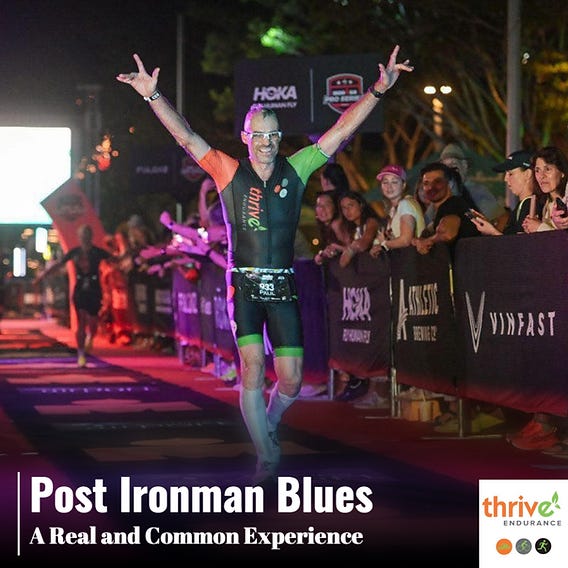
You have to try and discover what things you need to do to actually be happy, and what a fulfilling life looks like without scheduled achievement in the calendar. But that’s hard. So instead you are more likely to guilt-trip yourself into continuing all the training you were so excited to stop doing.
The cycling you hated becomes your normal routine, just because the alternative makes you sad. The comfort of routine becomes an addiction, you forgot how to dream your own dream.
Now that you’re training so much, you might as well sign up to another Ironman. But that doesn’t feel the same anymore, so maybe you’ll strive for a quicker time and need to train harder than before, or maybe you go for an Ultra Ironman, or a double wham bam thank you man racey wacey.
And this is where I think it all gets toxic. We chase a definition of success that was never ours, in order to get a feeling that won’t come and we become trapped in a lifestyle that was never planned. A prisoner to the bike, a slave to the track.
When a friend competed in his first Ironman, I remember looking up the finish rate. I had presumed it was pretty low and was fairly shocked to discover it was between 91% and 95%. Everyone who enters the race has done the work, aside from injuries and other factors, if you get as far as the start line you’re very likely going to find the finish line.
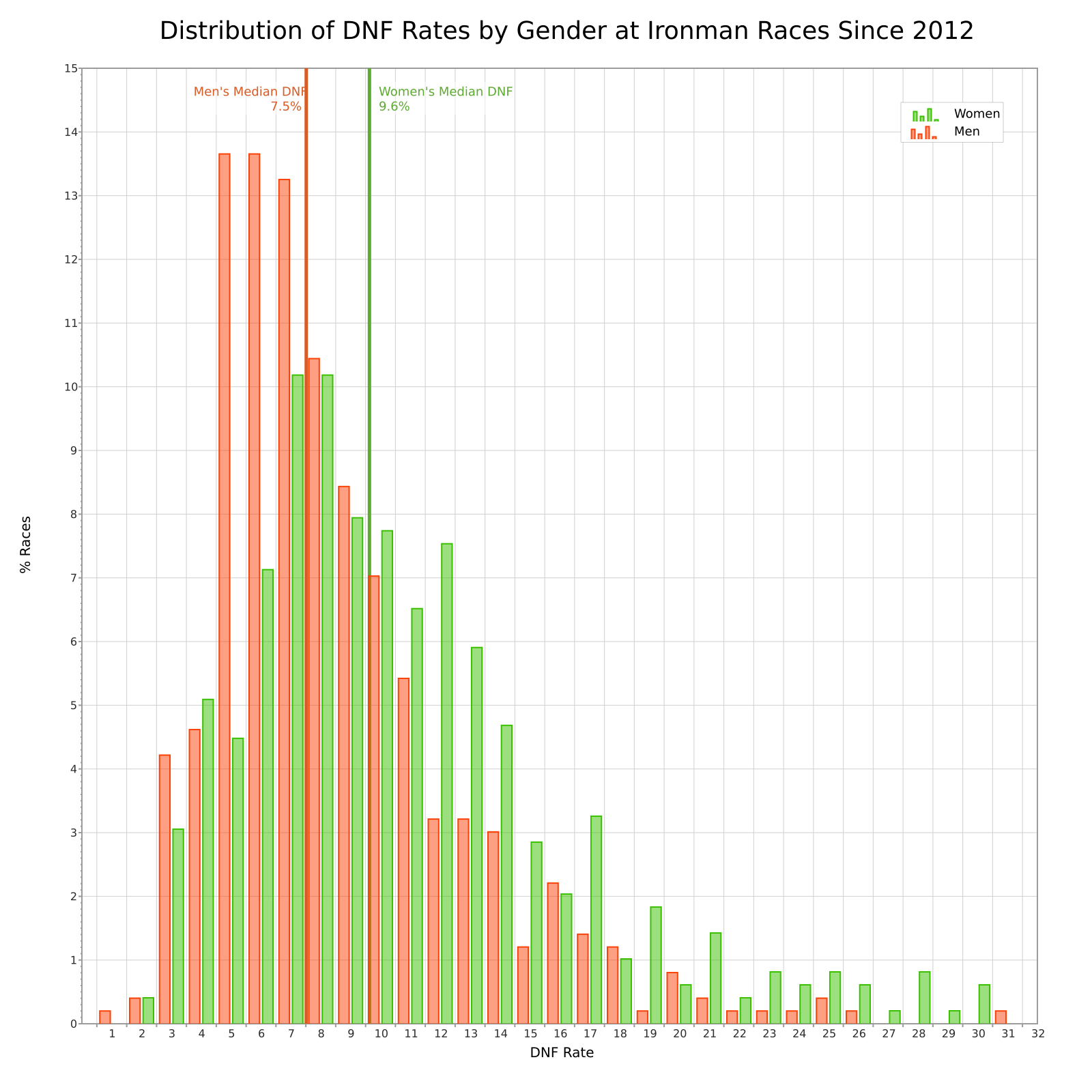
This rate of success is too high. It means that the trail has been blazed, if you stick to the assigned homework you will get the result. The hard things in life are those that have no pretext to success. Every week I post a Substack and some people read it (ily), sometimes I feel great about it and other times it feels like a poor use of time.
There is no guaranteed returned value on my time investment here, it takes a lot of discipline for me to show up each week pursuing a creative endeavour, knowing that it is statistically likely to lead to nothing. 80-90% of accounts stop publishing on Substack after the first year. 90% of start-ups fail. 91% of first time Ironman runners complete the race.
And yes, I can already feel the Woop wearers getting upset here. It is true that Ironman competitors self-select, that of course the finish rate is high but that doesn’t take into account all of the people who dropped out of competing before race day. All those who gave up training during the year.
But I wonder how many of those people weren’t just weak or less-than. I wonder how many of them just thought there were better ways to spend their time and they got really bored of swimming 50 laps a week. The failure rate might be higher but I don’t know how many can be attributed to failing. If we are not free to change our minds then we are not free at all.
In order for true, lasting satisfaction to be achieved you need to pursue things that are subjectively challenging not just objectively hard.
People sometimes ask me about my advice on investing and one thing I always suggest doing is a mental exercise of your current portfolio. Let’s say you had $10k and it is currently invested in 5 different coins/stocks, if instead you just had $10k in cash, would you invest it in the same places? Would the allocations look the same? If not, then it’s probably time to make a change.
I think the same is true for time. Some of us are fortunate enough to have unpredictable days, but for most, an average day is fairly defined. We know roughly how much we spend on doing the things we need to do, the things we want to do and how much time we have realistically left over.
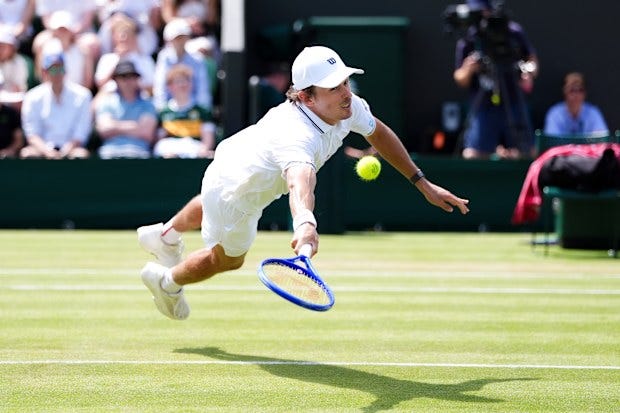
It is never too late to do a full stocktake on your time, naturally the easiest and most discussed is screen time, but that’s not the only place to find spare time. I’ve recently been surfing less and playing tennis more. Summer means the waves are smaller and more crowded, but the weather is better and the days are longer, so a reallocation to tennis and beach time makes sense for me. Everything is seasonal.
Doing a stocktake on your own schedule is uncomfortable because it makes you question how you spend your only real resource, that of time. It is uncomfortable because it challenges you to be better. That discomfort is the opposite side of the Ironman coin. The compliance of a known schedule resulting in a known goal.
Ironmans teach us that success is linear and that a known output will result in defined achievement. But life is not this simple, success is messy and unpredictable. Success to everyone looks different, it is a subjective pursuit. When we take subjective things and view them objectively we fool ourselves into thinking we understand more than we really do.
The coolest part about still being alive is that none of your goals are unfinished. You are in control of what the entire race looks like and whether cycling has a place in your youth. Choose to strive towards the unknown, because that is where truly great things are achieved.
another great read! imo true fulfillment comes from feeling successful by your own definition of success. Internal validation >>> any external pat on the back/medals
Agree success means totally different things to different people. Where I live there are plenty of iron men and women and lots of lyrica and you don’t think anything of it. Success to me is living a good life and not hurting anyone. Enjoyed your essay.